




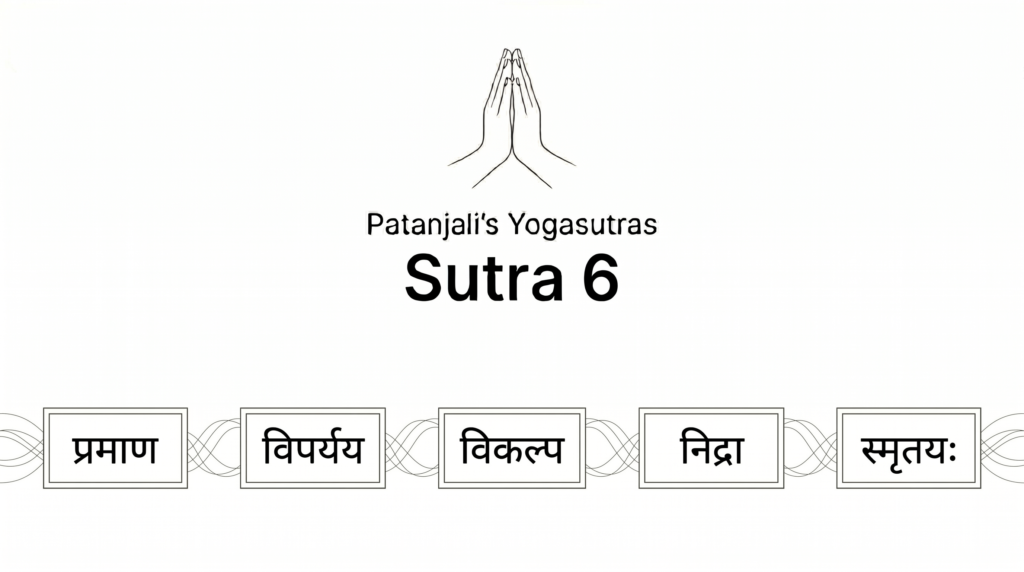
प्रमाणविपर्ययविकल्पनिद्रास्मृतयः ॥६॥
पदविभाग: (separating individual words): प्रमाण-विपर्यय-विकल्प-निद्रा-स्मृतयः
(Note: This entire sutra is a single, continuous word. It is an Itaretara Dvandva Samasa, meaning a copulative compound where all members carry equal weight and are joined together like a list.)
अन्वय: (Rearranging in logical prose sequence): प्रमाण-विपर्यय-विकल्प-निद्रा-स्मृतयः (सन्ति)।
प्रतिपदार्थ: (word-by-word meaning): प्रमाण = right knowledge (or valid cognition), विपर्यय = misconception (or error), विकल्प = imagination (or verbal delusion), निद्रा = sleep, स्मृतयः = and memory, (सन्ति) = (are).
तात्पर्यम्: (final translation): Those five types of mental fluctuations are right knowledge, misconception, verbal delusion, sleep, and memory.
Further context on the 6th sutra in Patanjali’s Yogasutras
Patanjali lists pramāṇa as the very first of the five vrittis. In the immediate next sutra (1.7), Patanjali explicitly defines what constitutes pramāṇa by stating that direct perception, inference, and scriptural testimony are the sources of right knowledge.
In Yoga, the mind is the measuring tape for reality. When the mind comes into contact with an object through the senses (direct perception), logical deduction (inference), or trusted authority (scriptural testimony), and reflects that object exactly as it is without distortion, that specific mental fluctuation is called a प्रमाण वृत्ति. This constitutes one of the five kinds of the rippling disturbance the mind creates.
विपर्यय is the vritti of misconception or false knowledge. It occurs when the mind perceives something contrary to its true nature, like mistaking a rope for a snake. It is an erroneous mental projection.
विकल्प occurs when a mental wave is generated entirely by words, lacking any objective reality. Imagining a “rabbit’s horn” is vikalpa, a concept born of language but completely devoid of any substance. Colloquially, in Hindi and Marathi, विकल्प refers to “options” or an “alternative”. My assertion is that विकल्प can be and have to be many but there is only one way to express reality as is, which is not different from the feeling of is-ness / being that pervades through the Universe.
निद्रा translates to “deep sleep” or “dreamless sleep”. In Yoga, this sleep is the Vritti which embraces the feeling of voidness. We cannot have a memory of something we haven’t perceived but we do remember waking up after a good night’s sleep, proving that the mind was still recording something during deep sleep and hence there was a certain class of waves in the mind.
Lastly, स्मृतयः is the vritti of retaining past experiences. Patanjali defines it as not allowing an experienced object to slip away and through latent impressions (samskaras) from previous thoughts resurface into conscious awareness. Each memory is a wave. They create further ripples in the lake of the mind, interpolating with existing latent impressions which rise up at the given time to form a thought.
One thing to note is that Patanjali does not permanently lock any of the five vrittis into a strictly klishta (afflicted) or aklishta (unafflicted) box. They can be both, depending entirely on the context and direction of the thought.
Comments