


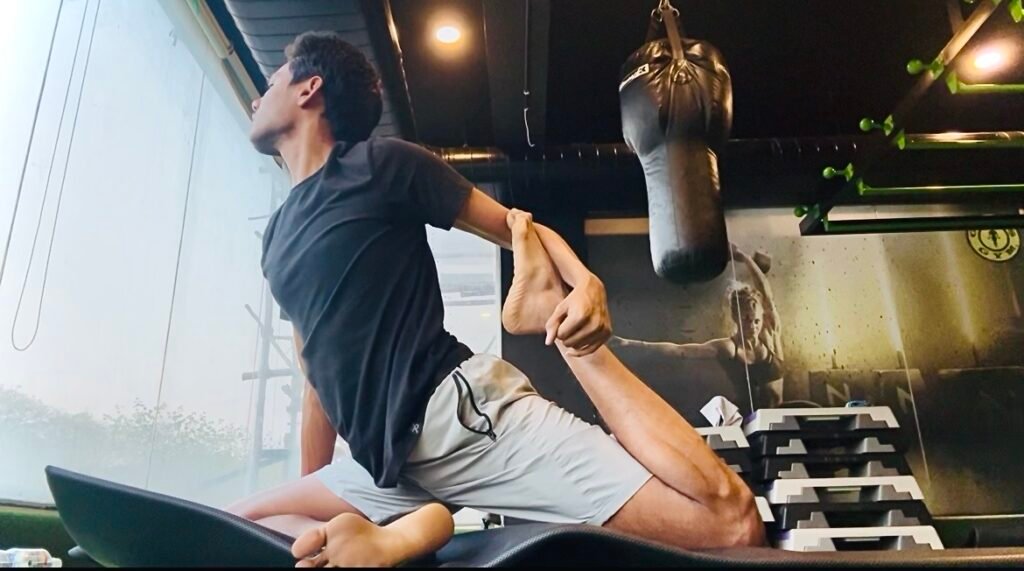
I have been practicing yoga for over four years now. While I don’t recall the exact reason I started, I do remember a vague evening during the COVID lockdowns. I was working out on the terrace and spontaneously aligned myself in the pigeon pose. At the time, my general notion was simply that we needed to stretch before and after workouts. It was a quiet evening, and as I tried touching my hands to my toes, I realized I couldn’t do it without bending my knees. This led me to the conclusion that my body was incredibly stiff. Believing this physical stiffness was also the root cause of my mental fog, I turned to yoga to gain more flexibility.
Like every newbie, I misunderstood yoga as mere gymnastics. I thought it was about reaching the far ends of the body, balancing on the head, contorting into bends and twists, flowing through asanas, and mimicking everything you see on the internet.
I have since come to realize it is none of those things. There is no single authority on this topic, and our modern world has stripped it of its true essence, repackaging and marketing it purely as a materialistic lifestyle.
Wrong.
The right term is Yogaḥ (योगः)
Firstly, the correct term is Yogah, not Yoga. It is a Sanskrit word that ends with a visarga (ः), signifying a slight gush of air after the shabda (word).
While modern-day yoga has been heavily popularized by the West, the Western world was actually introduced to it by none other than Swami Vivekananda. During his famous speech at the Parliament of the World’s Religions in Chicago, he spoke at length about the four dimensions of this spiritual discipline: Bhakti Yoga, Karma Yoga, Jnana Yoga, and Raja Yoga. Long before this global introduction, Yogaḥ had been practiced across India since time immemorial.
The word itself is derived from the Sanskrit dhatu (root verb) yuj. This root translates to uniting, binding, or attaching. On a deeper, practical level, it means to first cultivate an awareness within the body and then purposefully direct it as per our will.
It is one of the six Darshanas (ways of witnessing reality) within the Indian Knowledge System.
Timeline of events in the evolution of modern-day Yogaḥ
- Late 19th Century: Western intellectuals began exploring Indian Knowledge Systems and spiritual philosophy out of academic interest.
- 1893: Swami Vivekananda played a pivotal role by lecturing across the US and Europe, formally introducing Vedanta and Yoga philosophy to the global stage.
- Early 20th Century: Teachers like T. Krishnamacharya, along with his students B.K.S. Iyengar and K. Pattabhi Jois, popularized the physical postures (asanas) of Hatha yoga.
- 1950s to 1970s: Media and cultural shifts accelerated its reach. Richard Hittleman introduced yoga on television in 1961. Soon after, the hippie counterculture, the New Age movement, and celebrities like the Beatles (alongside Maharishi Mahesh Yogi) propelled it into pop culture.
- 1980s Onward: The practice became heavily institutionalized. Ashrams and yoga studios multiplied. Coupled with the rise of fitness culture and home videos, yoga was adapted to focus heavily on physical fitness, stress reduction, and mental health.
Yogaḥ before 19th century
Like all schools of thought in India, the roots of yoga date back to antiquity. Lord Shiva is revered as the Adiyogi (the first yogi), who showed the world 112 ways to transcend human limitations.
Then came Patanjali, the legendary sage, grammarian, and philosopher, who compiled the Yogasutras, which remains the central text on the subject. There are 196 sutras in total, yet interestingly, only three of them discuss asanas or the physical aspect of the practice. The rest of the text focuses heavily on meditation, human psychology, and how one can find communion with the universal spirit.
These Yogasutras are built upon Samkhya philosophy. At its core, Samkhya is about attaining moksha (liberation) by distinguishing the Purusha (the self or pure consciousness) from the Prakriti (matter or nature).
During my research, I also came across a few more essential texts and treatises that fall under the Yogaḥ Darshana:
- Vyasa Bhasya: A foundational commentary on the Yogasutras.
- Tattva Vaisharadi: A detailed sub-commentary on the Vyasa Bhasya.
- Rajamartanda: A commentary on the Yogasutras written by King Bhoja.
- Yoga Varttika: Another significant commentary on the Vyasa Bhasya.
How was it practised in ancient India?
The Yogasutras fall under the category of Smritis. This means the core teachings were memorized and passed down through generations via the Guru-Shishya parampara (teacher-student tradition). In that sense, it was always the people—the great yogis—who carried the knowledge forward. Yoga was never institutionalized in the modern sense of the word. Rather, the gurus and their shishyas were the institution.
This is a remarkably vast subject, and I don’t believe I am fully capable of quantifying the complete historical evolution of yoga just yet. For now, this is where my knowledge stands. I plan to return to this topic with a much deeper understanding and will update this section as I continue to learn.
What is Yogaḥ?
As per my current understanding, Patanjali offers a clear definition in the second sutra of the first chapter of the Yogasutras. He states that Yoga is Chitta-Vritti-Nirodha.
To break that down:
- Chitta is the “mind stuff” or the mind in its totality. It comprises manas (the individual mind), buddhi (intelligence), and ahamkara (the ego).
- Vritti refers to the fact that this mind constantly undergoes modifications or fluctuations, resulting in a mental state that is not fully pure.
- Nirodha is the active restraint or cessation of those mental fluctuations.
What I have realized through practicing yoga is that these mental modifications are physically stored within us. Our body is essentially the total expression of our mental state. This concept is beautifully elaborated in Bessel van der Kolk’s book, The Body Keeps the Score. Through yoga, we identify these localized tensions, bring the light of awareness to them, and consistently work to release them. The ultimate goal is to arrive at a physical state where peace is abundant and we can conduct ourselves with absolute ease.
This is echoed in the Katha Upanishad: “When the senses are stilled, when the mind is at rest, when the intellect wavers not, then, say the wise, is reached the highest state. This steady state of the senses and mind has been defined as Yoga. He who attains this is free from delusion.”
The eight limbs of Yogaḥ
To achieve this state, the Yogasutras categorize the practice into eight angas (limbs):
- Yama: Social ethics, restraints, and universal moral commandments.
- Niyama: Personal observances and habits (such as cleanliness, contentment, austerity, self-study, and devotion).
- Asana: Physical postures, specifically designed to be steady and comfortable.
- Pranayama: Control of the breath or life force.
- Pratyahara: The withdrawal of the senses from external distractions.
- Dharana: Concentration or one-pointed focus.
- Dhyana: Deep meditation.
- Samadhi: Complete absorption or union with the self and the divine.
There is a lot of technical detail to cover, and documenting this journey is a long-term project that I will keep refining as I go. My goal with this directory is to explore the various facets of yoga, delving much deeper into each of the eight limbs and the 196 sutras of Patanjali.
The whole intent here is to grow as I write and practice daily. There will certainly be a lot to reflect upon and make sense of along the way. Super excited for what awaits ahead.
Comments