Bhagavad Gita Chapter 2 Verse 47: As I Understand it at 26
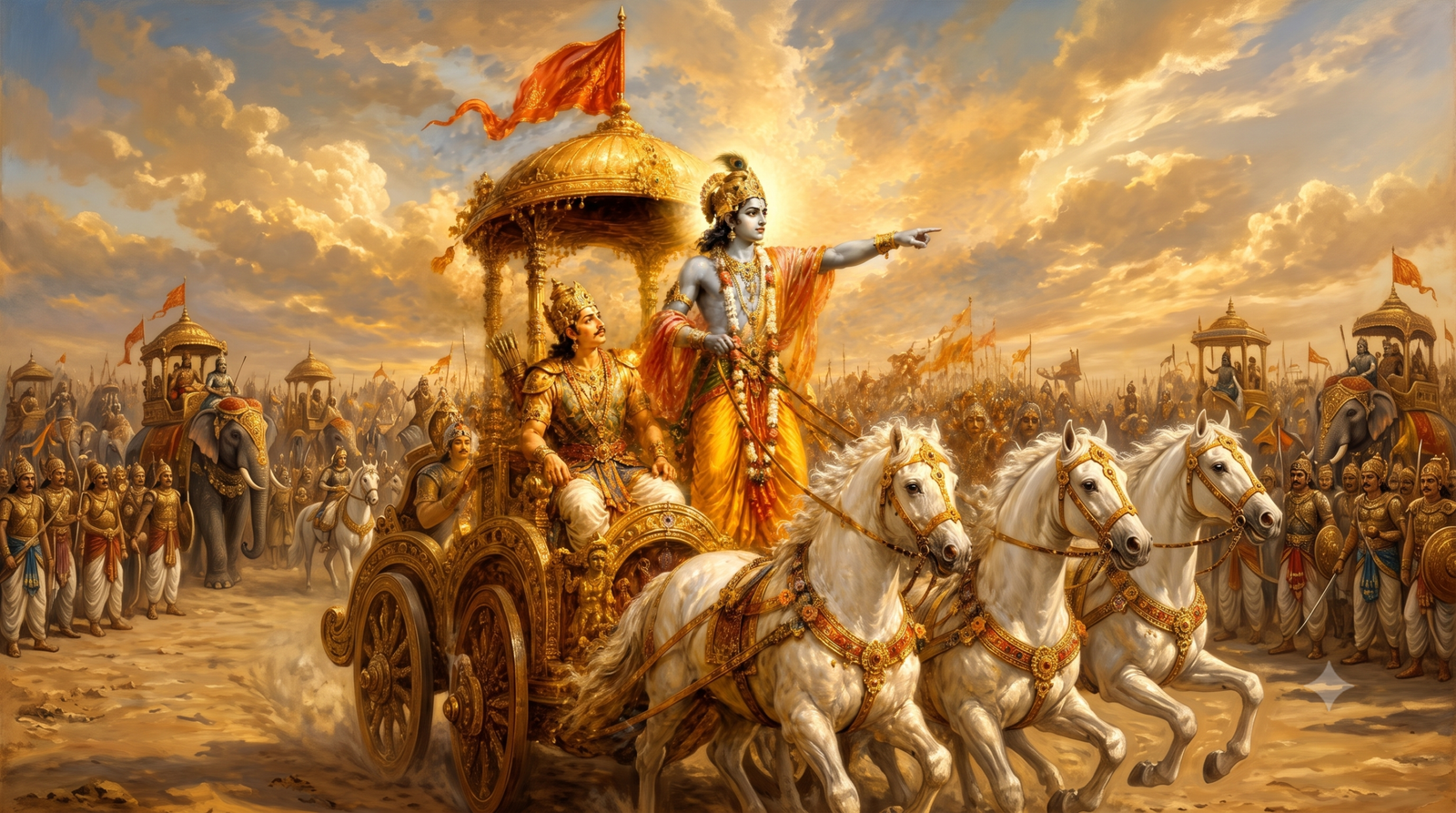
Dharmakshetre Kurukshetre. The Bhagavad Gita, or the Song of God, opens with these exact words. They set the premise for the profound revelations delivered to Arjuna by Krishna in the very midst of a battlefield.
I have interpreted this to mean that the battlefield of war is the battlefield of life. In it are the fundamental truths of our existence. If you want to know what it is, then you must step up and fight, O Arjuna.
It has been over three years since I first began trying to understand the Gita and implement its teachings into my daily life. As someone who has always loved reading, discussing, and debating various philosophies, I found that this scripture dismantled my ego.
Almost all Indian philosophies begin with stating that humans are inherently ignorant, and the ultimate goal of life is to move closer to our spiritual core. Because of this, the process of understanding this ancient dialogue between Arjuna and Krishna felt much more like an undoing of life so far.
It made me aware of the sheer amount of ignorance I had accumulated over the years. I realized I was blindly chasing goals preordained by society. Continuing down that path until I was forty would have been catastrophic. By then, the damage would have been irreversible. I initially picked up this text with a simple intent to figure out who I truly am.
I am 26, and I claim no authority over this topic. I am writing this piece to put my thoughts together on the very popular Chapter 2, Verse 47 based on what I have learnt so far.
Let us first establish a few basic facts that will help ground our understanding of this verse:
- The Bhagavad Gita is an incidental spiritual revelation occurring within the epic poem, the Mahabharata.
- The Mahabharata is the longest epic poem ever written, consisting of one lakh verses.
- Out of those, the Gita spans 700 verses across 18 chapters.
- The Mahabharata itself is divided into 18 parvas, or books. The Gita is found in the Bhishma Parva, which is the sixth book.
- It takes place at a dramatic moment when the massive armies of the Kauravas and Pandavas have gathered on the battlefield of Kurukshetra, and a grief-stricken Arjuna is struck by a moral dilemma.
- The war lasted for 18 days. The dialogue between Arjuna and Krishna acts as a timeline within a timeline, a pocket of space where Arjuna gains supreme spiritual insight. It might have been an instant awakening, and maybe there was some time dilation at play here.
- Chapter 2 is titled Sankhya Yoga, or the yoga of analytical knowledge. It begins with Arjuna’s surrender as he seeks guidance from Krishna.
- Krishna then teaches him the immortal nature of the Atman, the inescapable call to duty, the science of Karma Yoga, and the qualities of a sthitaprajna, a person of steady wisdom.
- Verse 47 acts almost like a mnemonic for the core message of the entire scripture. Millions of Indians chant it during funeral rites, and countless educational institutions use it as their foundational vision statement.
What exactly does this verse say that strikes such a chord with so many people? I want to make an attempt at unpacking it.
कर्मण्येवाधिकारस्ते मा फलेषु कदाचन।
मा कर्मफलहेतुर्भूर्मा ते सङ्गोऽस्त्वकर्मणि॥
The verse has four parts to it:
- Do your duty without worrying about the results.
- The fruits of your action are not for your enjoyment.
- Even while working, you must give up the pride of doership.
- Do not be attached to inaction.
Act you must. At a granular level, our work is already defined for us. I am writing, someone is riding a scooter on the road, birds are chirping, and all the involuntary functions of my body are constantly running. It is often said that the true purpose of life is simply to “do” exactly what you are doing right now. This verse looks at life as the absolute culmination of space, time, and causation leading up to this exact instant.
The point is to perform your duty in this present moment to the best of your capacity, always aiming to give your 100%. The loss of will, or the tendency to cling to inaction, usually happens only when our temporary emotions overpower what needs to be done right now.
The broader perspective here is that all our labels, identities, emotions, attachments, and even our physical bodies are transient. We are caught in the midst of an ever flowing stream of time and causation.
So, the question we must ask is this. If work simply happens, who are we to claim the doership?
Our name, our culture, and our identity were all given to us. However, the actual role we play in society is completely independent of those things. Think of a train arriving at a junction. Its name, number, time of origin, and destination are only as useful as the purpose they serve to keep the train moving. The role of the train is simply to keep moving within the guardrails of where it is built to function.
A tree does not devour its own fruits. A train does not run for its own sake. There is a larger matrix at play here, and this kshetra, or playground, is where we must act. The fruits of our actions are just there. The world will make of them what it wants to.
Given all this, what is the point of taking pride in labels we did not even choose?
Work simply happens, and you are right in the middle of it. Act you must, just as your heart does not question whether it needs to beat or not.
If my actions are colored entirely by what I expect to get out of them, then my effort will never reach its full potential. Just how we don’t write an exam to score a 100, but rather our actions (in this case preparation) determines whether we will score a 100 or not.
Between me and my work, what is this unnecessary chatter of the mind? Where does it originate, and why do we take it so seriously?
This verse asks us to surrender the fruits of our actions to the world and commit entirely to the effort itself. Why? Because how we respond to a situation and the sheer effort we put forward are the only things within our control.
Every cause has an effect. It would probably take a supercomputer to precisely map each effect back to its exact cause in a world that is already a complex web of countless overlapping variables. Therefore, you have the right only to what you do, and never to the results it produces. The ultimate ask is to shift from seeing yourself as the sole result bearer to becoming a steady observer with a discerning mind.
If doing what is demanded of us right now is a fundamental imperative, why add the extra layer of worrying about the results? It makes no sense to carry that burden, especially when the worry does absolutely nothing to improve our actual actions.
One thing to note about this verse is that the word कर्म (karma) is used in the singular case. It grammatically refers to a single task. This implies that our full effort must go toward one action at a time. We are simply not programmed for multitasking at the level of the mind.
Modern research supports the argument that our frontal lobe cannot handle the load of dividing attention across different actions. Even at a physical level, each organ system performs its own specific set of duties without taking on the role of another. We can certainly automate many of our daily habits, but our conscious mental involvement in an action is always singular. That absolute, undivided focus is what ultimately defines the quality of our work.
To conclude, this is my current understanding of the verse based purely on my lived experience so far. Communities across India have spent millennia deciphering what the Bhagavad Gita is trying to convey. Spiritual giants like Shankaracharya, Madhvacharya, Ramanujacharya, Madhusudan Saraswati, and modern thinkers like Bal Gangadhar Tilak have all written commentaries on it.
I am nowhere close to grasping what these masters have gained from this scripture. My current understanding remains strictly in the realm of tark, or logic. There is an entire dimension of bhakti (devotion) and jnana (knowledge) that I hope to uncover as I grow. My intent is to revisit this exact verse every year around this time to sharpen and actualize my learnings.
Until then, Jai Shree Krishna.